How to Talk to Your Partner About the Mental Load Without Starting a Fight
TLDR; To talk to your partner about the mental load without starting a fight, pick a calm moment and start by owning how you’ve been showing up. Then name the real enemy, which is the sheer amount two people are expected to carry right now, and keep coming back to how you feel in the relationship instead of arguing over who does more.
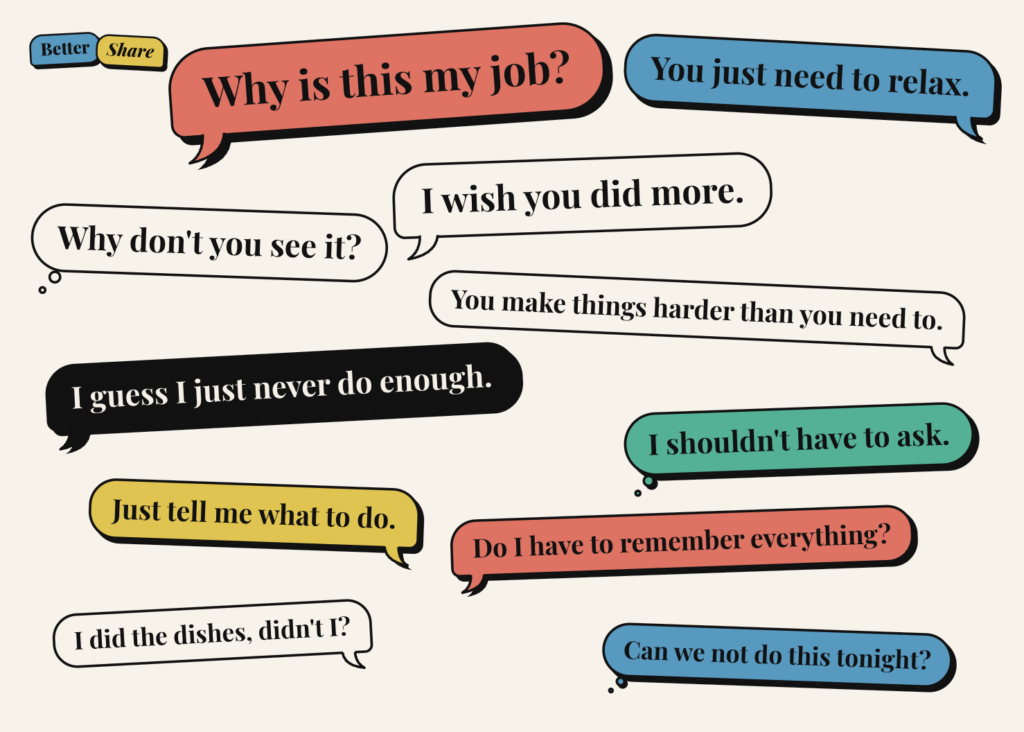
“I’m the one who’s working all day. I’m already maxed out.”
“I make the money, so that’s what I’m in charge of.”
“You’re saying I still don’t do enough? Guess it’s just never enough for you.”
“You’re making it harder than you need to. Your standards are too high. You just need to relax a little bit, I promise you.”
While I have a doctorate in psychology and I’ve specialized in relationships for over 20 years, I am not superhuman, and neither is my husband. He’s a great guy, for sure. There’s no doubt about that. But he’s also a regular guy. He’s a bro. He’s a dude. He works in the construction industry, works long hours, and travels every single week for work.
We have some unique circumstances when it comes to how we navigate home and family life, but I promise you, we have had almost every argument in the book when it comes to the mental load. Over the years, however, and over countless conversations, we finally aligned, for the most part, on what it is, how heavy it is, how different each of ours looks, and how we can best care for each other along the way.
I may be biased as someone who studies relationships and wrote a book on the mental load (A Better Share) from a relational perspective, but I believe one of the most transformative experiences around the mental load isn’t necessarily splitting things differently. It’s the way you and your partner navigate life together. It’s how you feel in your relationship despite the busyness and chaos of life. Because while the mental load can be shared differently and more evenly, and you can outsource the heck out of it, at the end of the day it’s not really going anywhere.
There will be somebody who is often anticipating things a bit more than the other person. There will be somebody who spends more time with the kids, knows them better, and is therefore often more tuned in to their preferences and needs. The mental load continually shifts day to day, depending on who’s sick, what’s going on at work, your stress levels, the season of life, or maybe something bigger like having another baby or a job promotion. Whatever it is, life will continue to add to your plate. Life will continue to throw you curveballs, and the mental load will continue to change in demand and intensity.
One of the greatest flexes in this area of life is being able to talk about it with your partner without it turning into a major ordeal.
I’m writing this to you as somebody who has studied the mental load with both default and non-default partners, who has interviewed both, who has written a book on the topic, and who has lived it herself.
Here are some of the best strategies for talking about the mental load with your partner without starting a fight.
1. Choose your time wisely
When you talk about it matters.
I realize this might be common sense, but for years I would bring up some of the most sensitive issues right before my husband and I were either going to bed or about to have sex. I’ve since realized this is actually pretty common.
Both of these are vulnerable acts. Sleeping next to each other at night, completely surrendering to rest, is a bit of a vulnerable thing. Having sex is absolutely a vulnerable act. So feeling like things are resolved and at peace, and that you’re on good terms with each other before you engage in either one, just makes sense.
However, I’m sad to report that this almost never works out well.
Instead, you go to bed angry, sex doesn’t even happen, and you stir the pot, resolving nothing. Because one of you (my husband) inevitably would say he was too tired to continue the conversation, and we’d have to bring the whole thing up again the next day.
A few other times that probably aren’t the best:
- When your partner has just walked in the door from work.
- When you’re headed to a double date, or out on the first date you’ve been putting off since your kids were born. Probably not the best time for a deep conversation that’s potentially really inflammatory.
I’m not suggesting that you twist and turn and bend and contort yourself in all these different ways in order to best serve your partner. I’m just saying set yourself up for success and be mindful of when you initiate the conversation. It’s hard to bring it up when things are going well. Who wants to rock the boat? But that is exactly when the conversation can be the most impactful and have the best outcome.
2. Own the way you show up
By the time you’re ready to have the conversation about the mental load, it’s likely you’ve already been steeping in your frustration which may have even developed some resentment.
Often, when default partners (let’s be frank, it’s usually women) finally bring up the mental load with their partner, they are at their wit’s end. They’ve bottled it up, and now they’re going to blow. They might be eking out little comments under their breath. They might be stomping around the house muttering, “Why am I the only one who notices this crap?” or “Who said this was my job?”
So by the time the conversation finally happens, a lot of times it just comes out as an angry, frustrated rant. This is totally understandable. It’s also not very effective.
As has become a popular line (even though it’s been around for ages), two things can be true at the same time. You can be angry, and you can also have a calm, productive conversation. You can be frustrated, and you can also have a conversation in a way that sets it up for the most success.
While it might feel like your partner doesn’t notice anything that needs doing around the house or what anyone needs, I have no doubt they have noticed your tension and irritability.
If this doesn’t apply to you, skip to the next one. But if it does, I’m going to challenge you to have some humility here.
For a lot of men in particular, when they notice their partner is tense or stressed, they do the one thing that is the least helpful: they pull back. They start to disengage in an attempt to preserve their peace and avoid having your tension and irritability come at them. This is the opposite of what we want them to do, but it’s often the impact it has on how they show up in the relationship.
So one of the first steps as you start this conversation is to acknowledge the way you’re coming across. This isn’t saying your frustration doesn’t make sense, it’s just offering some context and hedging defensiveness by owning your part. It sounds like this:
“As you may have noticed, I’ve been a little more tense and irritable lately. There’s a reason for this that I’ll get to in a minute, but I don’t like the way I’ve been, and I’m sure you don’t enjoy it either. I’m hoping we can come up with a solution that will help alleviate some of what I’m feeling.”
Now, if your partner agrees with you when you admit to being frustrated and irritable, that might spark up more frustration and irritation. I want to encourage you to just keep calm and carry on.
3. Get clear on the enemy
This might ruffle some feathers, but it is a hill I’m willing to die on.
Keep the end goal in mind, which is that you want to shift the way you and your partner navigate life together. If you’re going to do this, it’s important that the two of you are able to talk about it and get on the same page.
I suggest to you that the problem is not only “I have a partner who needs to do more.” It’s “We are navigating life in a crazy time in history.”
Life is busy, and the standards are higher than ever. Armchair experts are all over the place, raising the bar on what it means to be healthy, have an organized home, have a healthy relationship, decorate your home, dress with effortless style, and raise good kids. Every one of those comes with its own list of shoulds, and every should piles more on our plates.
Work doesn’t stay at work anymore, either. It follows us home on our phones and into our evenings and weekends. Usually both partners have to be working to support a family, because the cost of living is so freaking expensive. And yes, the pressure reaches our kids too. For example, our son is 10, and most of the kids he plays baseball with have had private coaches since they were 8. Say what?! It’s hard not to feel some sense of overwhelm.
Therefore all this stuff on your plates, the busyness of life, the pressure to perform, the standards you’re trying to meet, the exorbitant cost of living…these things are the enemy to your relationship. Not each other.
Here’s how you can phrase this…
“Let’s agree. Life is busy. We’re probably both really exhausted, and we have a lot on our plates. The reality is, all of this stuff is what our relationship, our family, and you and I are contending against. It is absolutely bananas how two people are supposed to manage all of this. That’s what the two of us are up against, it’s us vs. all of this.”
As you and your partner come together to talk about this, get clear on defining the enemy. Then the next ask is important, and it’s twofold:
- Explaining that the way you’re handling it now just isn’t working for you.
- Getting agreement that the two of you can come together and find a new path forward.
It might sound like this:
“The way you and I are currently navigating all this stuff is feeling a little bit heavy on my side. I’m not saying you’re not doing enough. I’m just saying I’m feeling really stressed and overwhelmed. I’m hoping the two of us can have a conversation about how we navigate all that we have on our plates. Sometimes this conversation can stir up defensiveness, so I want to be clear: this is really about how you and I function in the busyness of our life. This is not about pointing fingers. It’s about being more efficient, working better as a team, and just feeling better overall as we navigate our family life together.”
4. Make the invisible visible
If you’ve read my book, A Better Share, you know there are plenty of ways to define the mental load visually, specifically by describing the different sources of energy it takes to carry out all the tasks of invisible labor.
There’s the physical, which is what our partners tend to think it is: the actual doing of the things. This is why they say, “Make me a list.” They think it’s the doing. But then there’s also the mental and emotional labor, which I talk about in my book and an upcoming post (stay tuned).
These three are sort of like a Venn diagram, and at the center, where they intersect, is something I’ve coined the triple threat. This basically means that the majority of tasks in the invisible labor of home and family life require energy from all three domains. Every item on a to-do list unpacks to contain all the energy, effort, thought, heart, research, anticipation, and deep knowing that goes into it. That’s why it’s exhausting, and that’s why it takes up so much space in our brain.
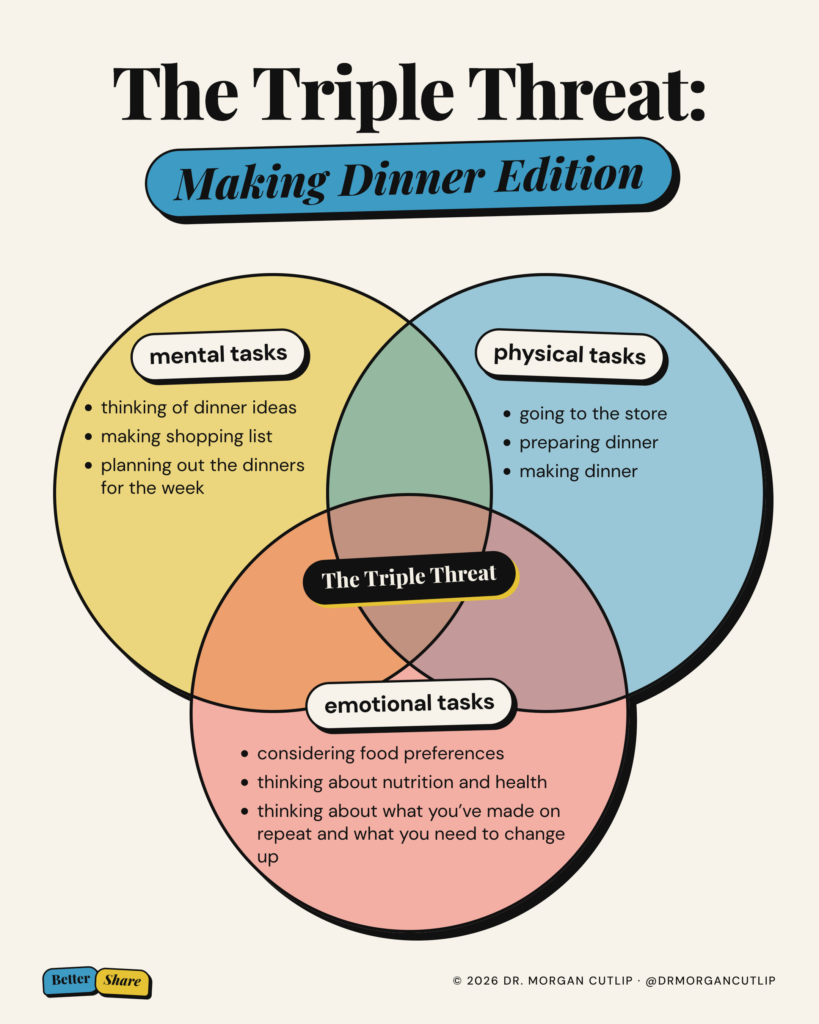
Oftentimes, explaining this to a partner might require a more technical visual like this one, or a visual you can easily pull from your own home and family life.
For example, I remember having a moment I’ve coined my epiphany from the pantry. I walked into our pantry (and I know it’s a privilege to have one you can actually step into), looked around, and realized I had been the only person to touch every single item in there. I pulled out a can of beans, and all of a sudden that can of beans personified all of the thought and energy and effort that has gone into how I make meals to care for our family. There was thinking of the recipe, putting them on a list, actually buying them, unpacking them, and reorganizing them. There’s so much that one single item can contain, and you can easily unpack it as an exercise to show a partner who’s really not getting it. Imagine it like a drop down box under an item that captures all three domains of the invisible labor that was necessary for it to “poof” itself into your home.
Applying the three energy domains (physical, mental, and emotional) to something going on in their work life can also help things click, because everybody has a mental load. Everybody carries these pieces. It’s just a matter of who’s doing the majority of it for home and family life, and if it’s feeling really disproportionate and unfair, an ultimately impacting your quality of life and relationship.
If you need a more thorough visual, the team at Better Share and I created an assessment called the Care Load Report. The content for the Care Load Report came out of my research with 537 default partners, as well as peer-reviewed studies on invisible labor.
One of the most frustrating parts of the conversation around the mental load is that there’s often a major perception gap. Before you even get to a place where you can talk about it, you start arguing about who’s doing more. That becomes the first argument you have to win just to progress to phase two of this dreaded conversation.
The Care Load Report is designed to assess several things:
- It measures who is doing which responsibilities at home.
- It measures the hours it takes to do them.
- It takes all of that information much further, asking a series of questions about you, your relationship, your life circumstances, your work hours, any dynamics that make it hard to let go of control, and whether ADHD is a factor.
- What you actually want/need to do to find a better share of the load.
A lot of times we might say things like, “I’m overwhelmed. I need you to do more,” but it’s not actually tied to anything tangible. The Care Load Report handles all of that for you. All you’ve got to do is answer some questions.
Once you’re done answering, it immediately gives you a very detailed, customized report on what the load distribution looks like in your home and family life, and it maps out the things that will actually move the needle so you can navigate this differently and function more as a team.
As a bonus, the assessment also generates a partner report, which translates your results for your partner in a way that won’t stir up defensiveness. If I’ve seen anything in my interviews, research, client conversations, and work with couples in this area, it’s that having a conversation that doesn’t spiral into dismissiveness, defensiveness, or the hardship Olympics is one of the hardest obstacles a couple has to overcome. That’s exactly what the partner report is for.
If you want to learn more, you can find the Care Load Report here.
5. Don’t take the bait on who does more
The final tip for talking about the mental load with your partner without starting a fight is to be careful about arguing over whether the mental load exists, or whose is heavier. These are landmines that will likely come up if the conversation doesn’t go well from the outset.
Maybe your partner will say things like, “Well, I make the money, so what do you expect me to do?” Or maybe they’ll say, “I feel like I’m already doing my fair share.” If you go down these paths and take the bait, you will likely end up somewhere in the weeds, having lost your point, totally overwhelmed and defeated, and feeling even more disrespected, invisible, and disconnected in your relationship.
Instead, keep coming back to this piece: the way I feel in our relationship is. For example,
“Regardless of whether you agree with the term or not, this is how I’m feeling in our relationship: stressed, overwhelmed, disconnected, and invisible. This is the part I’m most concerned about changing. It might require you doing some things you didn’t do before, but at the end of the day, the cost to you is likely really minimal, whereas the gain to us and our relationship is extremely high.
If we’re in this relationship and the point is that we care about and love each other, then we should care about how each of us feels in the relationship. I’m not trying to trick you. I’m not trying to overburden you. I’m trying to feel better in our relationship so it doesn’t start to harm our connection and our closeness.”
You’re on the same team, even if it doesn’t feel like it
The mental load will keep shifting as life does, and there will be seasons when one of you carries more. That’s normal. What matters is whether the two of you can keep talking about it, even when it’s hard, and keep finding fairness as things change.
My husband and I didn’t get here in one conversation. It took countless ones, plenty of them at the wrong time and in the wrong tone. But each time we came back to it, it got a little easier, and we got a little closer to feeling like we were facing it together instead of facing off.
So start with one conversation. Pick a good time, own your part, name the enemy, and keep coming back to how you feel in the relationship. You don’t have to get it perfect the first time. We certainly didn’t.