What Is the Mental Load Exactly? A Definition Even a First Grader Would Understand
by Dr. Morgan Cutlip
The mental load has had a real uptick lately. The term has gone viral, and it feels like every influencer and their brother is talking about it. It goes by a lot of names: domestic labor, invisible labor, the invisible load. And even though “the mental load” is the one used most, it’s actually used a bit incorrectly.
So what is it, exactly? And how do we understand it deeply enough that it actually empowers us to do something about it?
In my experience with women and couples, I find that the pain is really easy to describe: the overwhelm, the burnout, the “just over it” feeling that often accompanies a very heavy load. But when we can’t tie that to specific language, it becomes hard to do anything about it.
On top of that, the mental load conversation can be one of the most volatile talks a couple will have. For some reason, the mention of the “mental load” is like a man repeller, and “I need you to do a little bit more at home” tends to almost instantly pique defensiveness.
I mean, I get it. We’re living in a time when both partners are seemingly maxed out and exhausted, trying to provide a happy, healthy, comfortable home for our families. One more thing on our plates can feel like it will tip us over into complete and utter capacity.
But when you understand what it is and you have the words to describe it, it can empower you to do something different with it.
In this article, I’m going to give you one of the simplest definitions of the invisible labor of home and family life, and a visual to go with it.
What is the mental load?
The mental load is the seemingly never-ending running to-do list that we carry around in our heads. There are two defining features:
Invisibility. The majority of the tasks involved in the mental load are invisible. This makes them hard to hand off, hard to describe, and hard to receive appreciation for.
It occupies cognitive real estate. The mental load takes up cognitive real estate, meaning it crowds out space in our brains for things like creative capacity, regulating our emotions, remembering where we put the keys, and getting in the mood for sex.
Do I have your attention yet?
And an important disclaimer here: EVERYONE has a mental load. However, when it comes to the labor of home and family life, it is almost always carried predominantly by women. Even when they work full-time. Even when they make more than their partners.
A 2025 study of more than 2,000 U.S. parents found that mothers are mainly responsible for 67 percent more household management than fathers, and that this held regardless of whether mothers worked or how much they earned (Weeks, Kowalewska & Ruppanner, 2025). In my own study, The Mental State of the Mental Load, 84.5 percent of the 537 women surveyed identified as their family’s primary caregiver (Cutlip, 2026).
So this is why it’s SUCH a big deal. It’s disproportionate, it’s heavy, and it has a significant impact on women’s well-being and their relationships. In one study of 393 mothers, feeling solely responsible for running the household was linked to lower satisfaction with both their lives and their partnerships (Ciciolla & Luthar, 2019). In my study, women rated the stress the mental load adds to their lives an average of 4.31 out of 5 (Cutlip, 2025).
Why I call it the care load
“Mental” really only refers to the cognitive element of domestic labor, so it isn’t an accurate way to describe the whole thing. Because of that, from here on out, I’m going to call it the care load.
The care load is all of the work, both visible and invisible, that it takes to run a home and a family.
Hang with me just a bit longer to learn WHY this work is so heavy, and where our partners tend to lose the plot in the conversation.
The hands, the head, and the heart (here’s the part a first grader would get)
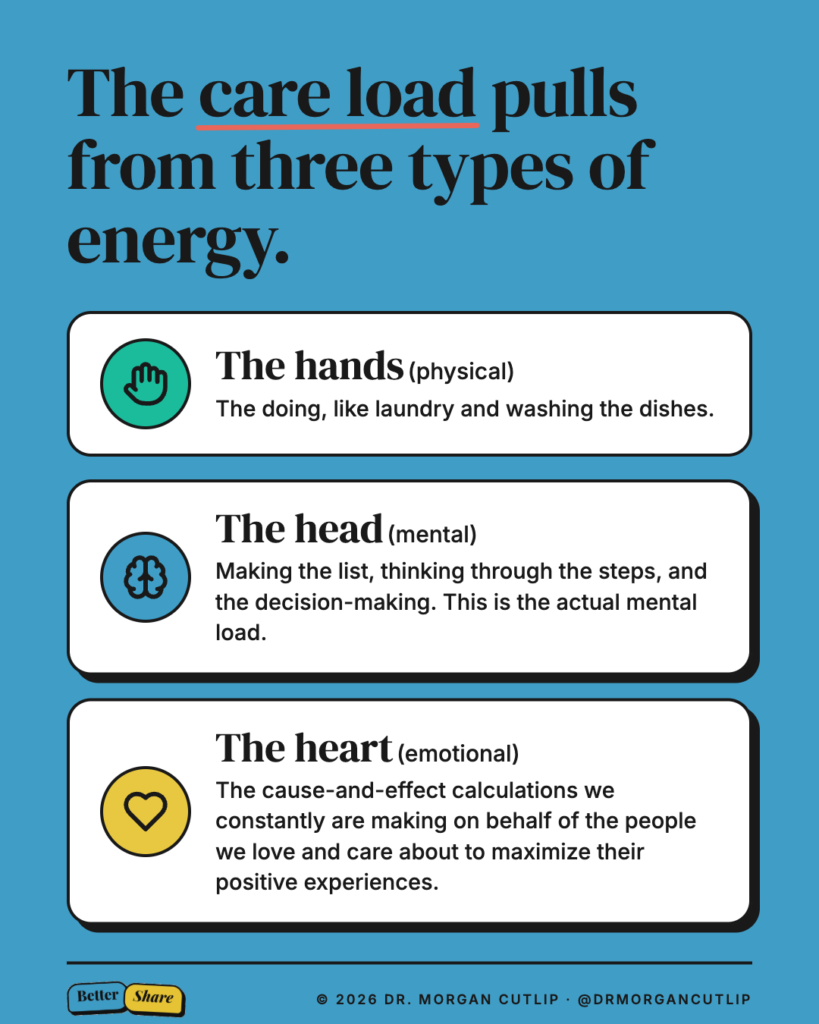
The care load pulls from three types of energy. The simplest way to think of it is energy from the hands, the head, and the heart. If we want to be a bit more technical:
- The hands (physical): the doing, like laundry and washing the dishes.
- The head (mental): making the list, thinking through the steps, and the decision-making. This is the actual mental load.
- The heart (emotional): Some people lump this in with the mental, but I like to pull it out on its own. My definition of emotional labor is the cause-and-effect calculations we are constantly making on behalf of the people we love and care about to maximize their positive experiences.
Why he says “but I help out”
Most of the time when a couple tries to talk about this, the woman brings it up and the man says, “Gosh, I do so much. I don’t understand. I help out.”
That reaction makes sense once you see why. The visible labor, the outcome of all the invisible work, is the easiest part to see. So partners (and it does tend to be men) assume the care load is only the physical domain.
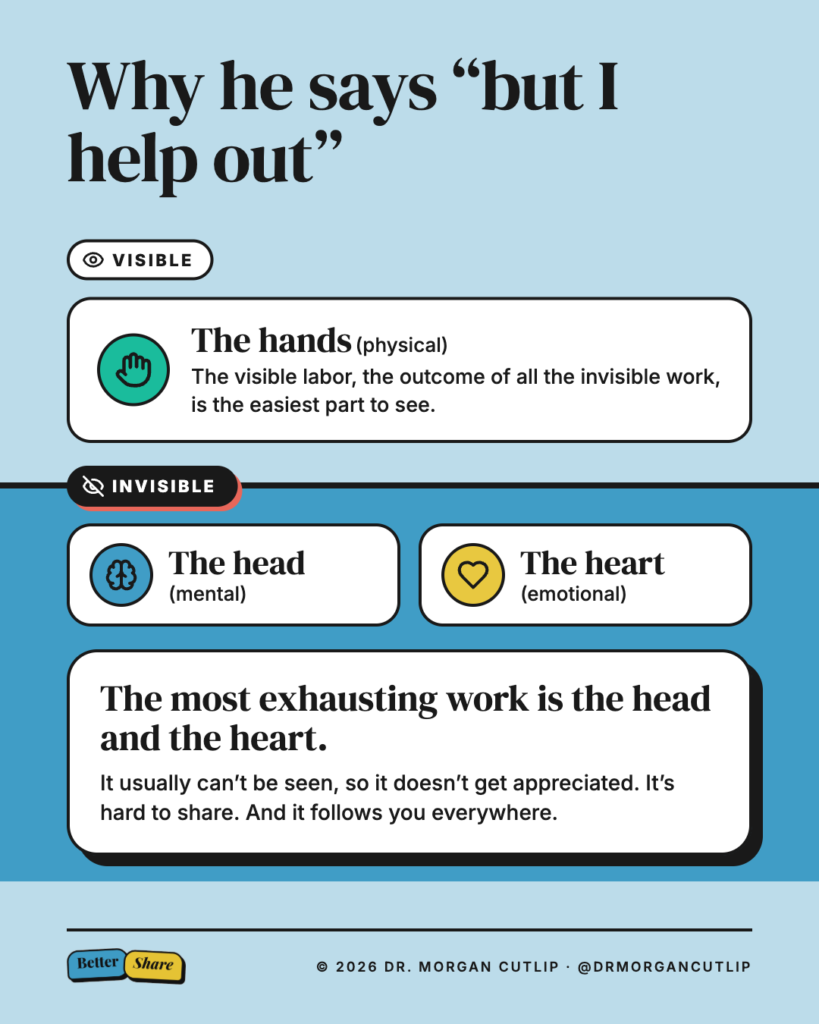
But the most exhausting work is the head and the heart. It usually can’t be seen, so it doesn’t get appreciated. It’s hard to share. And it follows you everywhere. You can be sitting at work and get flung out of the present moment into the overwhelm of decisions waiting for you. Plus, the stakes feel high, because one wrong decision on behalf of your kids can feel catastrophic.
The triple threat
Here’s the most important piece to understand: most tasks in home and family life sit at the intersection of the hands (physical), head (mental), and heart (emotional). I call that intersection the triple threat (Cutlip, 2025).
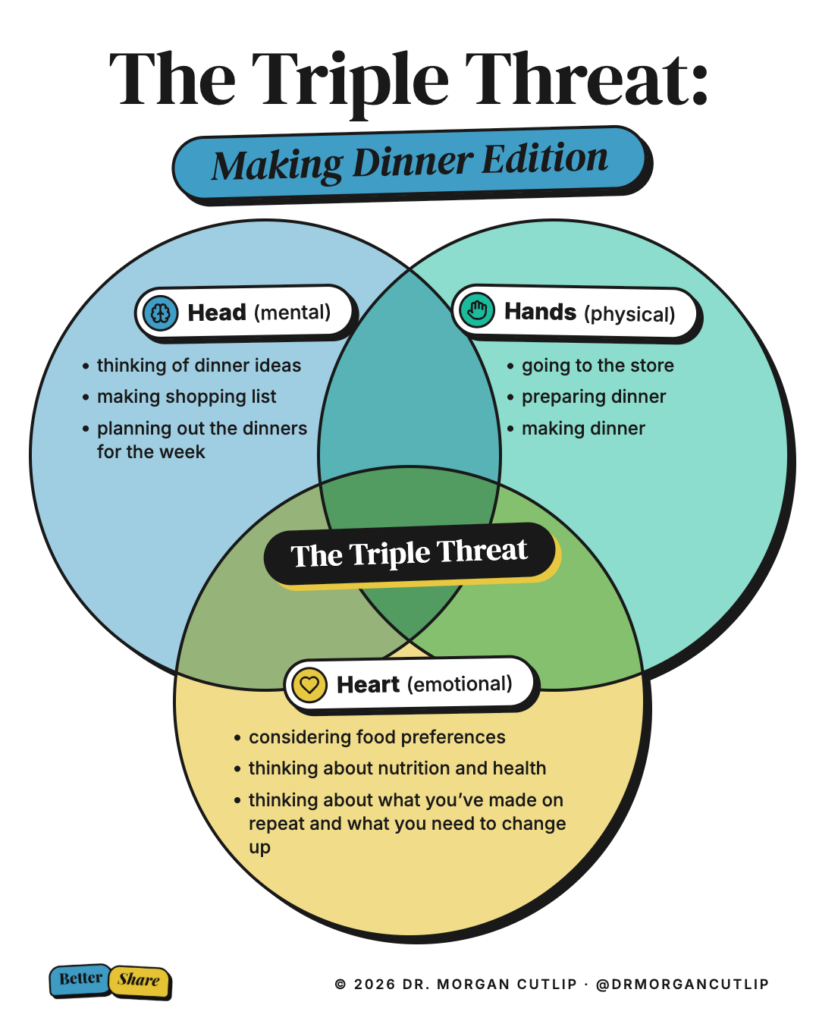
What this means is that nearly every item on a home and family to-do list unpacks to contain energy, effort, thought, and heart from all three domains. That’s what makes the care load so heavy and exhausting for the person carrying it, and so hard to see for the person who isn’t.
Take dinner. Most people think it’s just cooking dinner, because what they see is the piping hot meal on the plate. But the care load of dinner looks more like this:
- Looking through the fridge and pantry, and figuring out what to do about the ingredient that inevitably isn’t there
- Thinking through recipes and the nutrition your family needs
- Noticing everyone has had chicken four nights in a row and it’s time to switch it up
- Figuring out a meal everyone will actually eat, so nobody is begging for a granola bar at bedtime
- Getting to the grocery store and actually acquiring said food
- The chopping, sautéing, and cooking
- Plus cleanup
Dinner is never just dinner. And this is only one task.
Why it lands on one person: the deep knowing
One of the defining aspects of the head and heart work is that it requires a deep knowing of your family. And not having that deep knowing is what lets one partner, usually, check out and default the work to the other. “Hey, the kids prefer you.” “You just do it better than me.” “I’m not really sure how this is done.”
This often gets called weaponized incompetence. I have mixed feelings about that term, and I’ll save those for another post.
But here’s what matters: deep knowing is also the antidote. When both partners build it, both can step into the work of home and family life with more confidence and competence.
Making the care load visible to both of you
To build a deep knowing of how your home and family function, you both have to be able to see what you carry.
Once you see the care load laid out, you can’t unsee it. And that’s a good thing. Because you can’t share what neither of you can see.
The hard part is getting your partner to see it too, without the conversation turning into a debate over who does more. Here are some resources to help you get started:
- Draw the Venn diagram from above and talk through it with your partner. Seeing it this way can be really helpful.
- Check out my book, A Better Share. It’s not going to bash men, and you’ll both end up with a deeper understanding of each other and practical takeaways.
- The Care Load Report, for quick and powerful customized feedback. It’s a research-based assessment that gives you a clear picture of all the responsibilities it takes to run your family, what it costs you and your relationship, and the best next step to take first. It also comes with a customized partner guide that translates your results for your partner in a way that won’t stir up defensiveness.
It gives you both the same picture to work from, so you can stop arguing about whether the load exists and start figuring out how to carry it together.
References
Ciciolla, L., & Luthar, S. S. (2019). Invisible household labor and ramifications for adjustment: Mothers as captains of households. Sex Roles, 81(7–8), 467–486.
Cutlip, M. (2025). A Better Share. Thomas Nelson.
Cutlip, M. (2026). The State of the Mental Load volume 1. You can find the full report here
Weeks, A. C., Kowalewska, H., & Ruppanner, L. (2025). Take a load off? Not for mothers: Gender, cognitive labor, and the limits of time and money. Socius.
Photo credit: Sinitta Leunen
