Enough About the Dishes: What Women Carrying the Mental Load Are Actually Asking For
For as long as I can remember, the standard advice about the mental load has been the full handoff. Off her plate, out of her mind, into somebody else’s hands for good.
I have no doubt that handoffs are one of the most important ways to lighten the domestic labor and specifically the mental load. But the reality of busy family life is that sometimes there’s more to do than is reasonable for two people to handle. Even with a partner who is pulling their weight, the work can feel never-ending.
When I set out to write my book, A Better Share, I kept getting stuck on the solution. What is actually going to move the needle for people? What is it that women want to change?
Across the research and the self-help books, we’ve done a really good job of describing the problem. We know what the mental load does to women, to burnout, to mental and emotional health and to relationships. We have not done nearly as good a job of understanding what women are asking for from their partners.
If I’ve learned anything from my years of clinical and relationship education work, it’s that describing the pain is much easier than describing the change you want. We know what we don’t want. But do we know what we DO want?
In my book research, I asked 537 women what they most wanted from their partner around the load. 50% said for their partner to take more initiative, 31% said appreciation and only 8% said for their partner to take more on. I’ve been carrying that finding around ever since, wondering whether it would hold up.
What we asked 161 women about their mental load
Our first State of the Mental Load report looks at 161 women who completed the Care Load Report and are the default partner at home, which is the one who tracks and assigns the work.
Each woman looked at a list of 90 responsibilities of home and family life and marked the ones that apply to her household. For the typical woman, that was about 80. For each one, she told us who owns it, how much time it takes each week and what she wants to happen with it.
That last part is where it gets interesting. In an attempt to narrow down one of the most elusive questions of our time, “what do women want to be different?”, she could flag as many responsibilities as she liked. She could ask to be seen in it, meaning she wants her partner to recognize and appreciate her work. She could ask to share it, so both of them know how it’s done and either one can step in. Or she could ask her partner to take it over completely.
Based on the advice we’ve been giving for years, you’d expect her to ask for handoffs, however that’s not what we found.
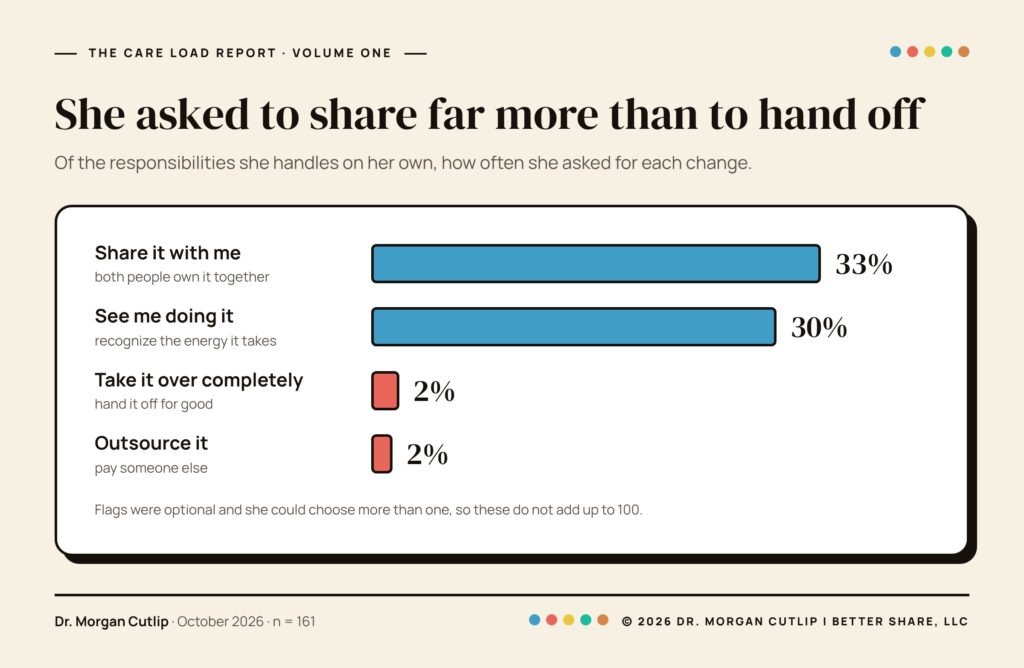
She asked to share far more than she asked to hand off
Of the responsibilities she holds on her own, she asked her partner to share 33% and to “see her” in 30%. She asked her partner to take over 2%.
These women had options, 98% used the flags, and 93% asked to share at least once. But 59% never asked their partner to take over a single thing.
Here’s what makes that even more interesting. When we asked in general what would help most, 81% chose an answer about relief from the load, like not being the default planner or getting things off her plate. So she does want relief. She just didn’t ask for it as a handoff when she was looking at her own list of responsibilities.
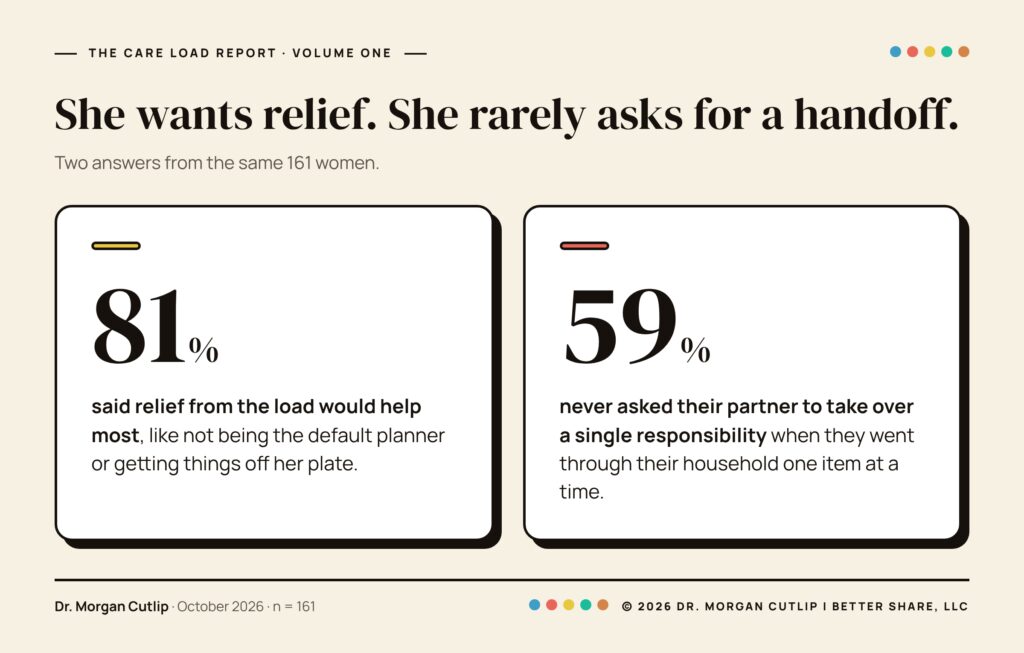
I don’t think those two answers contradict each other. I think relief, for a lot of women, means having someone in it with her. Someone who knows what’s going on, can pick up the ball when she drops it and is moving through family life alongside her. 22% said what would help most is trusting that things will get handled once she lets go. That’s the language of wanting a partner you can count on.
There’s another piece to this. 81% of women said they find it hard to let go, or that they hand something off and end up checking on it or redoing it. Those women were less satisfied in their relationship. We can’t tell which comes first. Sometimes the checking developed because she has a really passive partner which triggers her felt-need to control and manage. Sometimes she may have a tendency to control and manage which can lead to more passivity in her partner. Either way, the evidence suggests that many of households are somewhere in that loop.
The relational work is the part that matters most
We sorted her responsibilities into two kinds of work: relational and logistical. Relational work is the work of being a couple and a family: weekends, birthdays, holidays, emotional support and the part of parenting that’s about who your kids are becoming. Logistical work is the work of running the house: cleaning, laundry, bills, lunches and the school run.
Women who carried more of the relational work alone felt less appreciated and were less satisfied with intimacy in their relationship. When we compared women who carry the same amount of logistical work alone, the ones carrying more relational work alone also had more conflict about how the load is shared. Carrying more of the logistical work alone wasn’t connected to any of these outcomes.
This also showed up similarly in parenting. Being the only parent who teaches values, plays and handles the hard questions went along with feeling less appreciated. Being the only one who packs the lunches and does the school run did not.
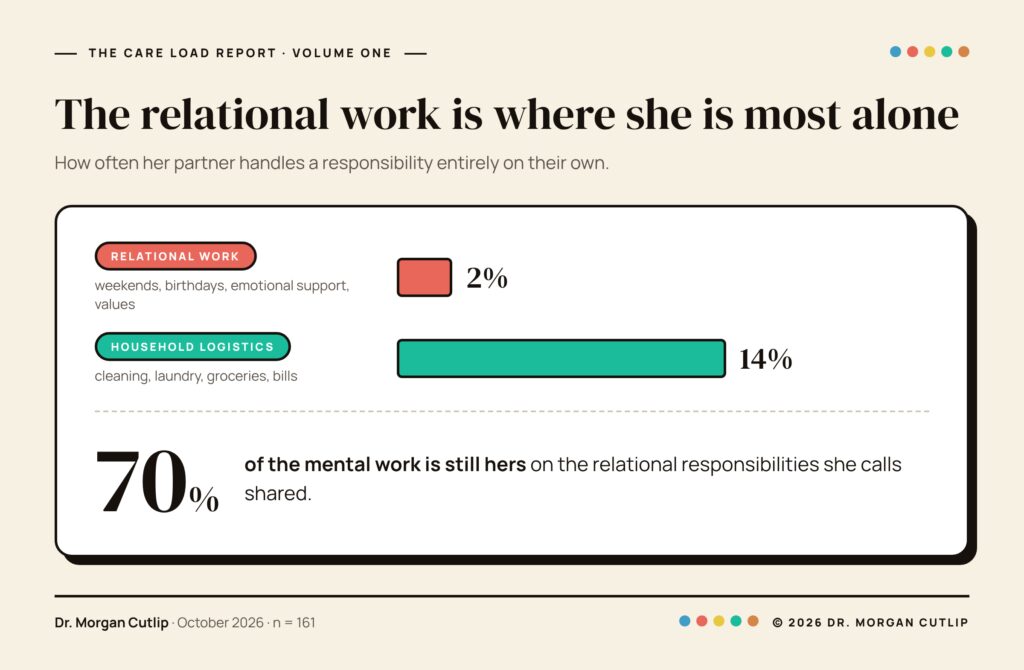
The relational work is also where she’s most alone. Her partner holds only 2% of relational responsibilities on their own, compared with 14% of household logistics. Even on the relational responsibilities she calls shared, she’s still doing 70% of the mental work.
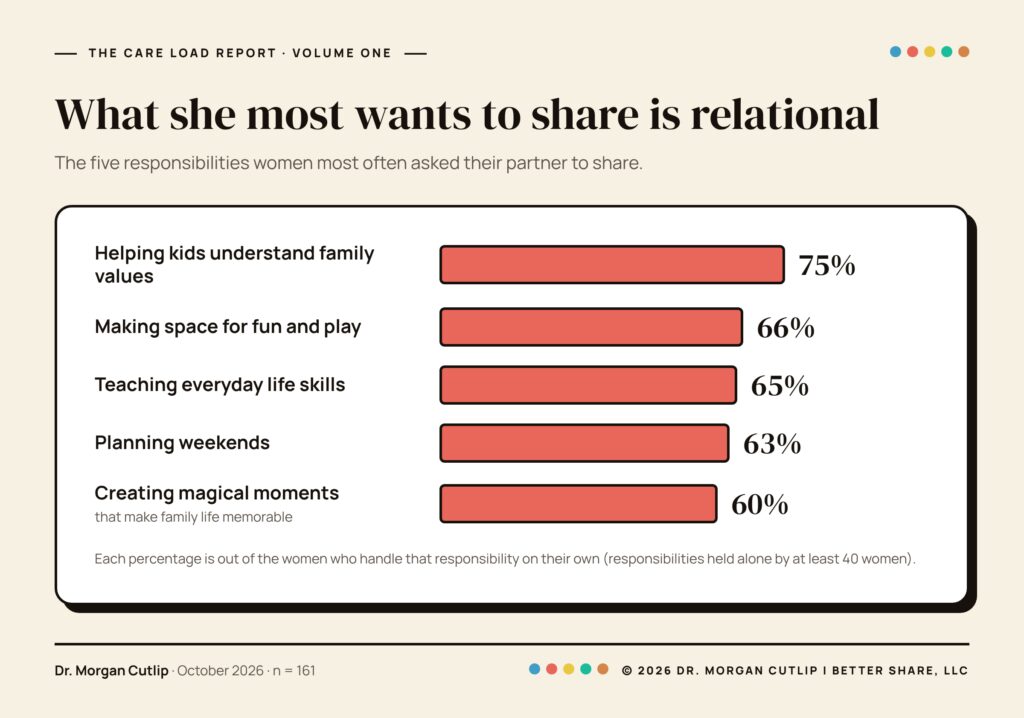
So it makes sense that the five responsibilities women most wanted to share were all relational. Each percentage is out of the women who handle that responsibility on their own:
- Helping kids understand family values (75%)
- Making space for fun and play (66%)
- Teaching everyday life skills (65%)
- Planning weekends (63%)
- Creating the magical moments that make family life memorable (60%)
Other recent research points in the same direction. In a 2026 study of 452 women in the UK, women whose partners took on more of the mental load were more satisfied with their relationship, and once the mental load was counted, how the physical housework was split no longer predicted their satisfaction (Klein, Ascigil, Oschatz, & Kahalon, 2026).
Feeling appreciated matters more than how much she does
52% of the women in our study were not at all or only a little satisfied in their relationship. Only 16% were quite or extremely satisfied.
When we looked at what best predicts her relationship satisfaction, three variables came out on top: how appreciated she feels, how fair the split of responsibilities feels to her and how often the two of them have conflict about it. Appreciation was the strongest of the three. Once we knew those three things, how much of the load she carries didn’t add anything to the prediction.
For the record please don’t interpret this as “just say thank you.” Appreciation doesn’t cancel out an unfair load, and fairness still matters. But being seen is a big part of how she feels at home and in the relationship, and it’s something a partner can start doing today to make a major impact. It takes nearly no time and costs nothing.
In my book, A Better Share, I give a formula for meaningful appreciation, which is “noticing (what someone does or a quality about them) + how it positively impacts your life”. The trick is to use more words when expressing meaningful appreciation.
What this means for couples, and for the professionals who help them
So what does this mean for couples trying to solve this in their own home, and for the professionals trying to help them?
Most of the tools offered today, and most of the advice, point to the full handoff. This data suggests we need more nuance than that, especially those of us who are deeply involved in this work with couples.
The research has done an excellent job of describing the problem and its impact. It hasn’t done a good job of explaining what leads to change. So I’m proposing a model to start organizing the mechanisms that actually lead to change around the work of home and family life: the Conceptual Model of Care Load Change. We call it the care load because the mental work is only one part of it. There’s also the emotional and the physical labor attached to the domestic care load of home and family life.
If we look at why this issue is so tricky, it’s because it sits at the intersection of our relational and logistical lives. To create meaningful change, we have to work on both. That’s why a couple who sets up a shared digital calendar, which is an excellent tool, doesn’t always feel the relief they hoped for. The same goes for a productivity app. Each one reaches part of what leads to change, however we need a more holistic approach.
Integrated Model of Care Load Change
by Dr. Morgan Cutlip
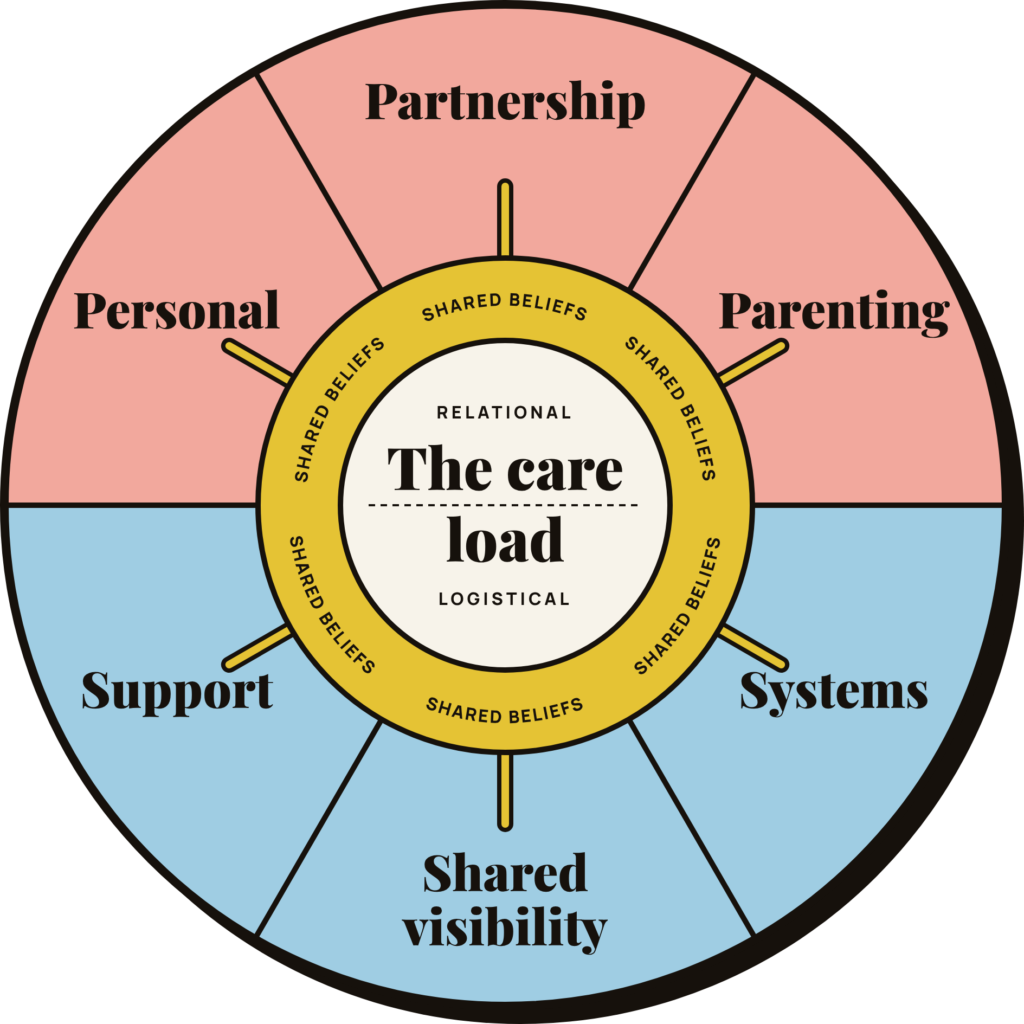
The model has six areas. Three are relational:
- Personal: what each of you brings in that affects how you show up, like guilt, maternal gatekeeping, defensiveness or ADHD.
- Partnership: how the two of you work together and talk about hard things.
- Parenting: whether you’re aligned on your values and can talk about parenting approaches without defensiveness getting in the way.
Three are logistical:
- Shared visibility: tools like digital calendars that make so much of the invisible schedule visible to both of you, an excel sheet of all the responsibilities of home and family life, etc.
- Support: help from outside the couple, like hiring a house manager (Sage Haus is a great example), outsourcing, carpools, a sitter, extended family and friends.
- Systems: the Etsy printables, the AI prompts and the apps that send a daily report of what’s going on and catch where a ball may have dropped.
At the center of all six are your shared beliefs: what each of you believes about fairness, gender roles, and values.
All of these are useful. But each area needs to be relatively intact for a solution to be meaningful and lasting. When we work with couples, factoring in all six is how we shape what happens next in a way that offers real relief.
If you’re interested in learning more about how to implement this Integrated Model of Care Load Change in your work with individuals and couples, we are offering a Care Load Report Certification to a select number of professionals. This training will provide access to the Care Load Report (the customized assessment used in this study) for use with clients in addition to how to support individuals and couples around the domestic labor in your work with them. You can learn more here.
Read the full report
This is just a fraction of what we found. The full report: State of the Mental Load volume 1 covers what women in this study carry, what they most want their partners to understand and the full Integrated Model of Care Load Change.
